
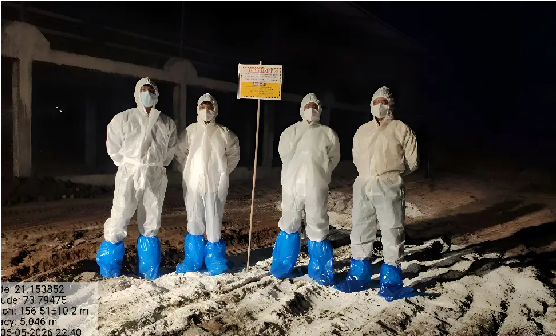
Maharashtra’s avian influenza containment drive in Navapur area of Nandurbar district has widened to nearly 200,000 layers across 14 commercial farms. The operation has dealt another blow to one of western India’s largest egg-producing belts, where farmers are still recovering from earlier outbreaks.
The first reports of unusual mortality came on April 12 and 13, when poultry owners alerted district veterinary officials of chickens dying in multiple sheds. Samples were sent to the National Institute of High Security Animal Diseases (NIHSAD), Bhopal, which later confirmed H5N1 infection in three commercial units.
Containment measures intensify
Following confirmation, the state Animal Husbandry Department directed Nandurbar authorities on May 1 to enforce the Centre’s avian influenza plan. Culling began the next day and was extended to all farms within the 1-km infected radius. Eggs, feed stocks, litter and reusable poultry material are being destroyed, while a 3-km movement‑control zone remains in force.
Navapur accounts for 27 of Nandurbar’s 38 commercial farms and produces about 1.2 million eggs daily for markets in Maharashtra, Gujarat and neighboring states. That concentration has made containment especially difficult. Feed trucks, egg pickup vehicles, labor crews and service teams move through the same corridor daily, leaving little separation between farms. Officials warn that lapses in sanitation or worker hygiene can spread infection quickly once it enters the area.
Farmers struggle with repeated losses
Navapur has faced avian flu before. It was part of India’s first major H5N1 outbreak in 2006 and another episode in 2021. Arif Balesariya, president of the Nandurbar Poultry Farms Association, said many operators are finding it increasingly difficult to recover after repeated culling cycles, delayed rebuilding and rising input costs. “This time we do not have the strength to rebuild after every outbreak,” he told aviNews Asia.
Mr Balesariya added that the latest culling will disrupt poultry inventory, egg dispatch, feed movement and flock replacement across Navapur’s production chain in the coming weeks.
Officials confirmed that no human infections have been detected so far.
Source- avinews
